
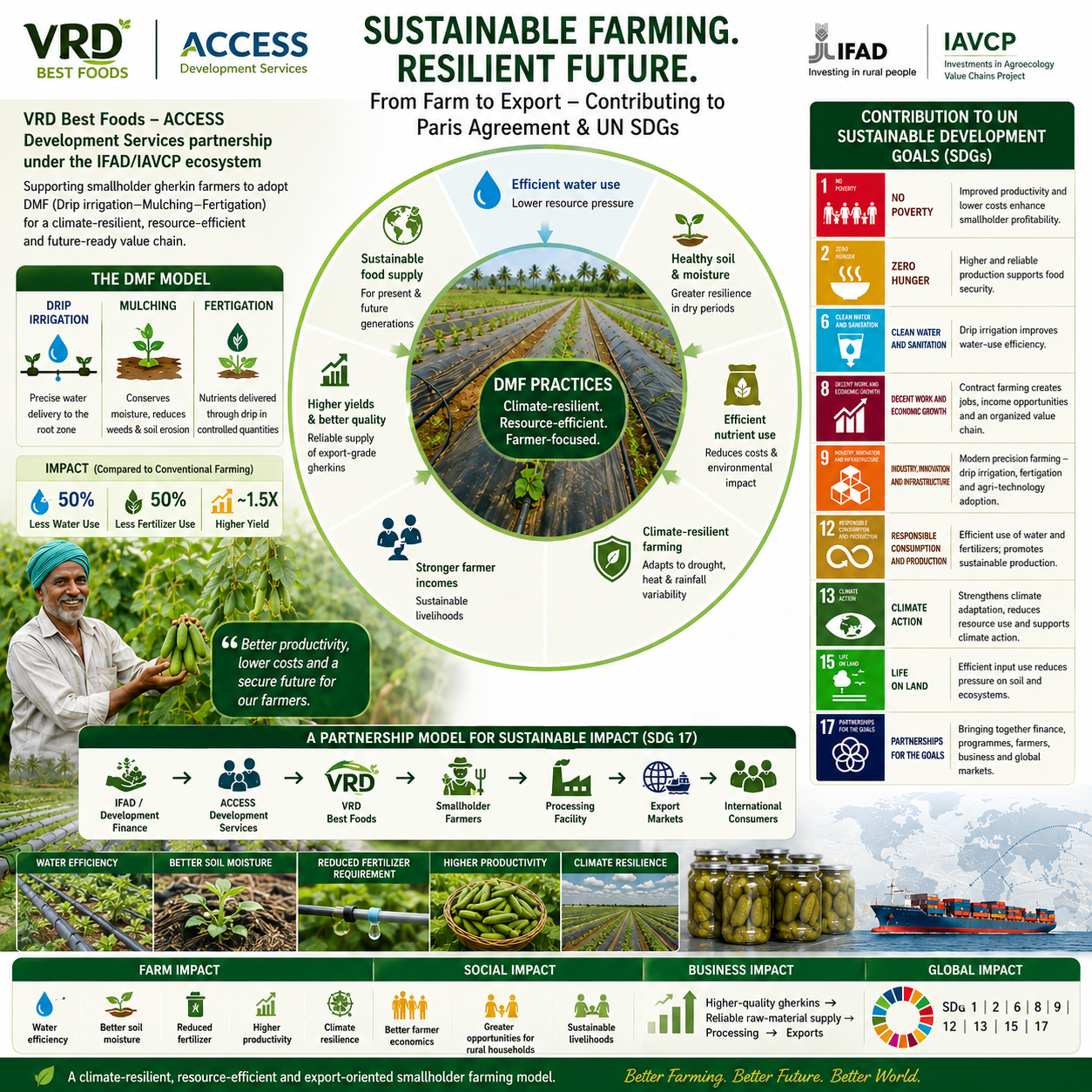
Sustainable Farming: Building a Resilient Future from Farm to Export
Sustainable farming is essential for building a resilient agricultural sector, improving farmers’ livelihoods, and protecting natural resources. As agriculture faces increasing challenges from water scarcity, changing weather patterns, rising input costs, and growing global food demand, adopting resource-efficient farming practices has become more important than ever.
VRD Best Foods, in partnership with ACCESS Development Services, supports sustainable and climate-resilient gherkin farming through the adoption of the Drip Irrigation–Mulching–Fertigation (DMF) model. This initiative, within the IFAD/IAVCP ecosystem, focuses on helping smallholder farmers improve resource efficiency, enhance productivity, and strengthen their participation in export-oriented agricultural value chains.
By connecting sustainable farming practices with food processing and international markets, the partnership demonstrates how responsible agriculture can contribute to a better future for farmers, businesses, communities, and the environment.
What Is the DMF Model in Sustainable Agriculture?
The DMF model combines three important agricultural practices: drip irrigation, mulching, and fertigation. Together, these techniques help farmers manage water, soil moisture, and nutrients more efficiently.
1. Drip Irrigation: Improving Water-Use Efficiency
Drip irrigation delivers water directly to the root zone of crops, helping farmers manage irrigation more precisely than conventional watering methods.
Key benefits include:
- More efficient water application.
- Reduced water loss when systems are properly managed.
- Better control over irrigation schedules.
- Support for crop production under water-stressed conditions.
Efficient irrigation is especially important for climate-resilient agriculture, where farmers must adapt to unpredictable rainfall and increasing pressure on water resources.
2. Mulching: Conserving Soil Moisture
Mulching involves covering the soil surface with suitable materials, such as agricultural mulch film, to help conserve moisture and manage weeds.
In gherkin cultivation, mulching can support better soil-moisture management and more effective crop establishment.
Key benefits include:
- Reduced moisture loss from the soil surface.
- Improved weed management.
- Better crop-growing conditions.
- Potential reductions in unnecessary irrigation and associated input use.
When selected and managed responsibly, mulching can contribute to more resource-efficient farming systems.
3. Fertigation: Delivering Nutrients Efficiently
Fertigation combines irrigation with the application of dissolved fertilizers through an irrigation system. It allows farmers to supply nutrients in measured quantities according to crop requirements.
Key benefits include:
- More controlled nutrient application.
- Improved fertilizer-use efficiency.
- Reduced risk of excessive fertilizer application when properly managed.
- Better coordination between irrigation and crop nutrition.
By integrating drip irrigation, mulching, and fertigation, the DMF model helps promote a more precise and efficient approach to gherkin farming.
How Sustainable Farming Benefits Smallholder Gherkin Farmers
Smallholder farmers play a vital role in agricultural supply chains. However, they often face challenges related to input costs, water availability, climate variability, crop quality, and access to reliable markets.
The DMF approach aims to address these challenges through improved farm management and resource efficiency.
Better Productivity and Crop Quality
Efficient water and nutrient management can help create more favorable growing conditions. With appropriate crop practices, farmers can work toward improved yields, consistent quality, and reliable supplies of export-grade gherkins.
Improved Input Management
Water and fertilizer are important agricultural inputs. Using them more efficiently can help farmers manage production costs and reduce unnecessary resource use.
Actual savings depend on farm conditions, irrigation practices, soil characteristics, and crop-management decisions.
Greater Climate Resilience
Climate-resilient agriculture focuses on helping farming systems cope with drought, heat, rainfall variability, and other environmental challenges.
The DMF model supports this objective by encouraging efficient irrigation, soil-moisture conservation, and better nutrient management.
Stronger Farmer Livelihoods
Improved productivity, better-quality produce, and reliable market linkages can create opportunities for stronger farm incomes. Sustainable farming initiatives can also contribute to long-term livelihood security when supported by suitable agricultural guidance and dependable value chains.
VRD Best Foods: Connecting Sustainable Farms to Global Markets
Sustainable agriculture delivers greater value when responsible farm practices are connected to efficient processing, quality management, and market access.
VRD Best Foods contributes to this approach through its role in the gherkin value chain, linking agricultural production with processing and export markets.
The partnership model brings together several stakeholders:
- IFAD and development finance: Supporting the broader development ecosystem.
- ACCESS Development Services: Contributing development services and support for agricultural value-chain initiatives.
- VRD Best Foods: Connecting farm-level production with processing and export-oriented supply chains.
- Smallholder farmers: Adopting improved farming practices and producing agricultural commodities.
- Processing facilities: Supporting the transformation of harvested produce into market-ready products.
- International markets: Creating opportunities for agricultural products to reach global consumers.
This farm-to-export approach highlights the importance of collaboration between farmers, development organizations, food processors, and international buyers.
When sustainability is integrated throughout the value chain, it can support responsible production while strengthening the connection between agricultural communities and global food markets.
How VRD Best Foods Contributes to the UN Sustainable Development Goals
The United Nations Sustainable Development Goals provide a global framework for addressing poverty, hunger, environmental challenges, and inclusive economic growth.
The sustainable farming initiative described here aligns with several SDGs.
SDG 1: No Poverty
Improved farm productivity, efficient input management, and access to organized value chains can create opportunities to strengthen smallholder farmers’ livelihoods and economic resilience.
SDG 2: Zero Hunger
More reliable agricultural production and resilient farming systems contribute to food-system stability and sustainable agricultural development.
SDG 6: Clean Water and Sanitation
Drip irrigation promotes more precise water application and can improve water-use efficiency when appropriately designed and maintained.
SDG 8: Decent Work and Economic Growth
Agricultural value-chain development can support rural economic activity and create opportunities across farming, processing, logistics, and exports.
SDG 9: Industry, Innovation and Infrastructure
Modern irrigation systems, improved nutrient management, agricultural technology, and efficient processing infrastructure encourage innovation throughout the food value chain.
SDG 12: Responsible Consumption and Production
Using water, fertilizers, and other agricultural inputs efficiently supports more responsible production practices and helps reduce avoidable resource waste.
SDG 13: Climate Action
Climate-resilient farming practices help farmers manage climate-related risks and adapt agricultural operations to changing environmental conditions.
SDG 15: Life on Land
Responsible soil and input management can help reduce pressure on agricultural ecosystems and support the long-term health of productive land.
SDG 17: Partnerships for the Goals
The collaboration among development services, farmers, food processors, and other value-chain stakeholders demonstrates the role of partnerships in advancing sustainable agricultural development.
These connections describe how the initiative aligns with the goals; they should not be interpreted as formal UN endorsement or verified achievement of every SDG target.
Measuring the Impact of Sustainable Farming
Sustainable agriculture should be evaluated through measurable outcomes, not just the adoption of new technologies.
For initiatives such as the DMF model, useful indicators include:
- Water used per acre or per kilogram of produce.
- Fertilizer use per acre and per unit of output.
- Crop yield and marketable produce quality.
- Production costs and net farm income.
- Soil-moisture management and crop performance during dry periods.
- Farmer participation and continued adoption of improved practices.
- The consistency and quality of produce supplied to processing facilities.
Monitoring these indicators helps farmers and value-chain partners understand which practices deliver meaningful environmental and economic benefits.
Any specific percentage improvement in water use, fertilizer use, or crop yield should be supported by documented baseline measurements and comparable farm-level data.
The Future of Climate-Resilient Agriculture in India
India’s agricultural future depends on improving productivity while managing natural resources responsibly. Efficient irrigation, better soil management, precision nutrient application, farmer training, and strong market connections can all contribute to more resilient farming systems.
For export-oriented crops such as gherkins, sustainability also involves maintaining consistent quality and coordinating farm-level production with processing requirements and international market expectations.
Through its association with ACCESS Development Services and the IFAD/IAVCP ecosystem, VRD Best Foods illustrates how agricultural value-chain partnerships can encourage resource-efficient farming and create opportunities for smallholder farmers.
Scaling these approaches will require continued farmer engagement, technical support, appropriate technology, environmental responsibility, and transparent measurement of results.
Conclusion: Better Farming, Better Future, Better World
Sustainable farming is more than an agricultural technique. It is an approach to building resilient livelihoods, using natural resources responsibly, and strengthening the connections between farmers and global markets.
By promoting the Drip Irrigation–Mulching–Fertigation model and participating in a collaborative farm-to-export value chain, VRD Best Foods and ACCESS Development Services highlight the potential of sustainable agriculture to support smallholder gherkin farmers and contribute to the wider objectives of the UN Sustainable Development Goals.
The way forward is clear: efficient resource use, climate-resilient farming, stronger farmer livelihoods, and responsible food production must work together to create lasting agricultural impact.
VRD Best Foods — Better Farming. Better Future. Better World.
Frequently Asked Questions (FAQs)
1. What is sustainable farming?
Sustainable farming involves agricultural practices that aim to maintain productivity while using water, soil, fertilizers, and other resources responsibly. It also considers farmers’ livelihoods and the long-term resilience of agricultural systems.
2. What is the DMF model in agriculture?
DMF stands for Drip Irrigation, Mulching, and Fertigation. The model combines efficient irrigation, soil-moisture conservation, and controlled nutrient delivery to support improved crop management.
3. How does drip irrigation help gherkin farmers?
Drip irrigation delivers water near the crop’s root zone, enabling more precise irrigation management and potentially reducing water losses compared with less targeted methods.
4. How does VRD Best Foods support sustainable agriculture?
VRD Best Foods participates in an export-oriented gherkin value chain and, through the partnership described with ACCESS Development Services, supports an approach that promotes resource-efficient farming and stronger links between smallholder farmers, processing, and markets.
5. Which UN Sustainable Development Goals are relevant to sustainable farming?
Relevant goals include SDG 1 (No Poverty), SDG 2 (Zero Hunger), SDG 6 (Clean Water and Sanitation), SDG 8 (Decent Work and Economic Growth), SDG 9 (Industry, Innovation and Infrastructure), SDG 12 (Responsible Consumption and Production), SDG 13 (Climate Action), SDG 15 (Life on Land), and SDG 17 (Partnerships for the Goals).
6. Why is climate-resilient farming important?
Climate-resilient farming helps agricultural systems prepare for and respond to drought, heat, rainfall variability, and other climate-related risks while supporting long-term productivity and farmer livelihoods.