
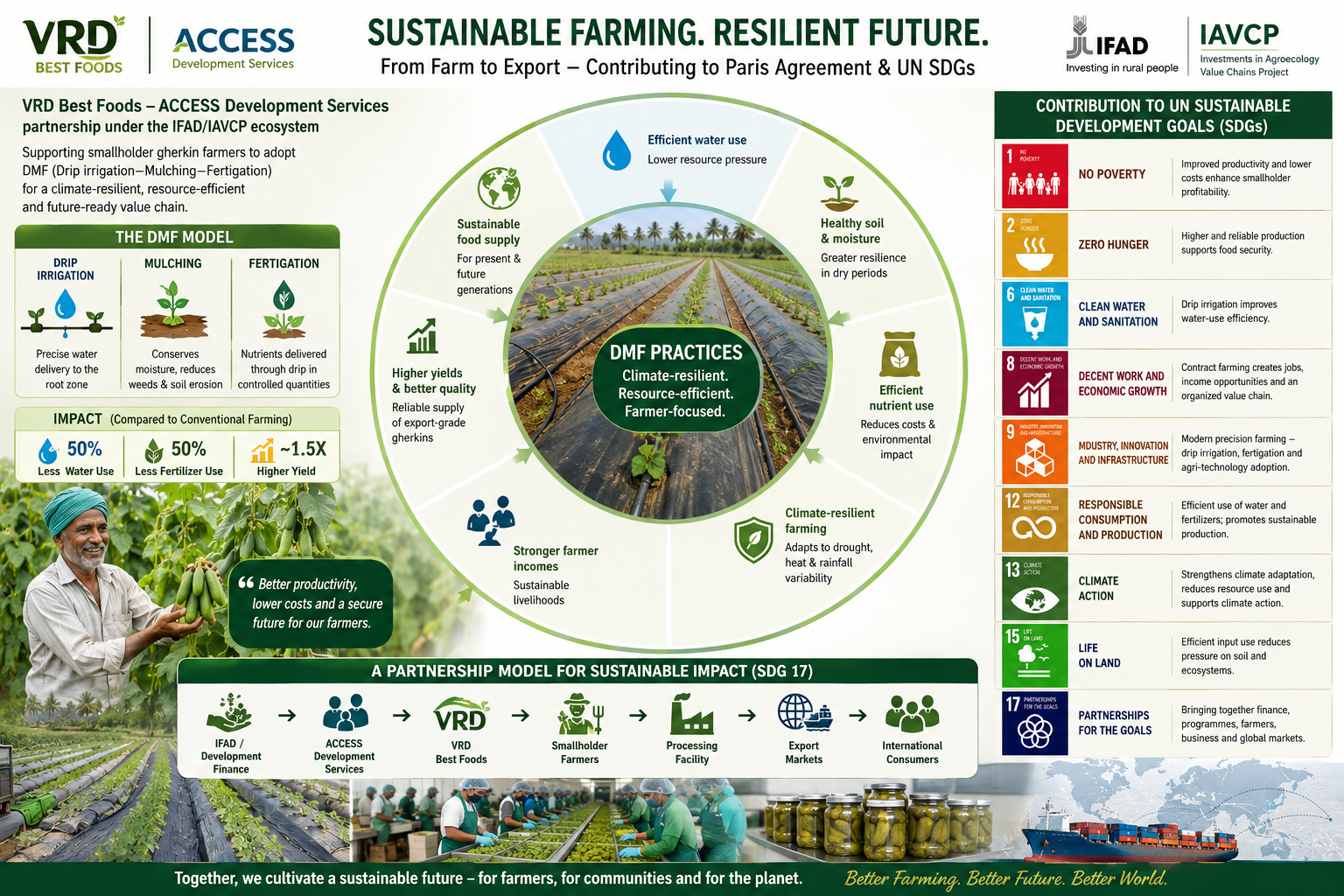
The VRD Best Foods–ACCESS Development Services association, particularly the DMF (Drip irrigation–Mulching–Fertigation) programme supported through the IFAD/IAVCP ecosystem, can be positioned as a practical “farm-to-export” contribution to both the Paris Agreement and the UN Sustainable Development Goals (SDGs).
IFAD specifically reports that VRD’s smallholder gherkin farmers transitioned to drip, mulching and fertigation with GAP Fund support, with the objectives of improving resource efficiency, increasing yields and reducing water and fertilizer use.
How it connects to the Paris Agreement
The Paris Agreement has two particularly relevant agricultural dimensions:
1. Climate adaptation – making farming more resilient to drought, heat and changing rainfall.
2. Climate mitigation – reducing resource consumption and, where possible, greenhouse-gas emissions.
The VRD model contributes as follows:
DMF → Efficient water use → Lower agricultural resource pressure → Climate-resilient farming → More stable farmer income → Sustainable food supply
Contribution to the key SDGs
SDG 1 – No Poverty – Better productivity and lower production costs can improve smallholder farmer profitability.
SDG 2 – Zero Hunger – Higher and more reliable agricultural production supports food security and sustainable agriculture.
SDG 6 – Clean Water – Drip irrigation improves water-use efficiency.
SDG 8 – Decent Work & Economic Growth – Contract farming creates an organized agricultural value chain and income opportunities.
SDG 9 – Industry, Innovation & Infrastructure – Introduces modern precision farming – drip irrigation, fertigation and agricultural technology.
SDG 12 – Responsible Production – Uses water and fertilizers (50% reduction in fertilizer use compared to conventional farming) more efficiently and promotes sustainable production.
SDG 13 – Climate Action – Helps farmers adapt to climate variability and supports climate-resilient agriculture.
SDG 15 – Life on Land – More efficient input use can reduce pressure on soil and surrounding ecosystems.
SDG 17 – Partnerships – Connects development finance, ACCESS, VRD, farmers and international markets.
The UN identifies SDGs 2, 6, 12, 13 and 15 as directly relevant to sustainable agriculture, water efficiency, responsible production, climate action and land ecosystems.
The strongest link is SDG 6 + SDG 13
- Drip irrigation → less water wastage→ improved water-use efficiency→ SDG 6
- Mulching → reduced evaporation→ improved soil moisture→ greater resilience during dry periods→ SDG 13
- Fertigation → precise nutrient application→ potentially 50% fertilizer consumption→ reduced production cost and environmental pressure→ SDG 12 + SDG 13
IFAD’s own assessment says the VRD farmers’ DMF transition is expected to increase yields by approximately 1.5 times while reducing water and fertilizer use.
- SDG 17 is particularly important
This is not just a farmer–company relationship.
It creates a partnership model:
IFAD / climate-development finance
↓
ACCESS Development Services – programme/value-chain support
↓
VRD Best Foods – commercial implementation
↓
Smallholder farmers – adoption of DMF
↓
Processing & export market
↓
International consumers
That directly reflects SDG 17 – Partnerships for the Goals, which the UN describes as strengthening the means of implementation and global partnerships for sustainable development.
The most important strategic point for VRD
> “A climate-resilient, resource-efficient and export-oriented smallholder farming model.”
FARM IMPACT
💧 Water efficiency
🌱 Better soil moisture
🧪 Reduced fertilizer requirement
🌾 Higher productivity
☀️ Climate resilience
↓
SOCIAL IMPACT
👨🌾 Better farmer economics
👩🌾 Greater opportunities for rural households
💼 Sustainable livelihoods
↓
BUSINESS IMPACT
Higher-quality gherkins → reliable raw-material supply → processing → exports
↓
GLOBAL IMPACT
SDG 1 | SDG 2 | SDG 6 | SDG 8 | SDG 12 | SDG 13 | SDG 15 | SDG 17
This is consistent with the FAO’s view that improving agricultural water management can simultaneously advance SDG 2, SDG 6 and SDG 13, while sustainable agriculture can also improve productivity, farmer income and environmental outcomes.
In short:
VRD demonstrates how a private food-export company can translate international climate and SDG objectives into measurable action at the individual farmer and farm level. That is potentially a very strong ESG story for VRD Best Foods.
For more information visit www.vrdbestfoods.in