
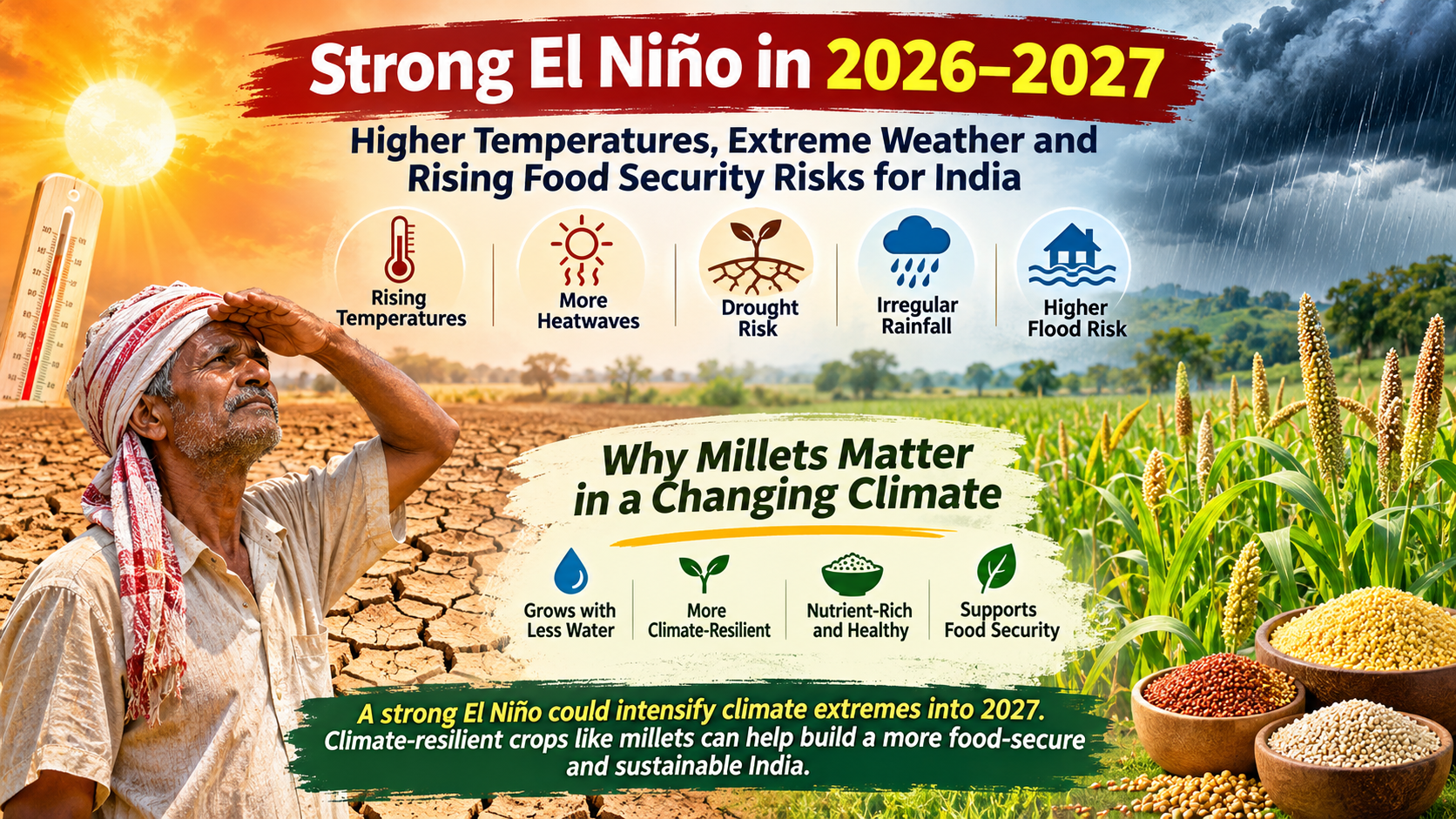
The world is facing another serious climate challenge. According to the World Meteorological Organization (WMO), a strong El Niño event is expected to intensify towards the end of 2026, with its effects potentially continuing into 2027.
This development raises concerns about rising temperatures, extreme heatwaves, irregular rainfall, droughts and floods across different parts of the world.
The concern is particularly significant for countries like India, where agriculture, water availability and millions of livelihoods depend heavily on seasonal weather patterns.
But what exactly is El Niño? Why is it becoming a global concern, and how could it affect India’s agriculture and food security?
Let’s understand.
1. What Is El Niño and Why Is It a Global Concern?
El Niño is a natural climate phenomenon associated with the unusual warming of surface waters in the central and eastern tropical Pacific Ocean.
It influences atmospheric circulation and changes temperature and rainfall patterns across different regions.
A strong El Niño can contribute to:
- Higher global average temperatures.
- Increased risk of heatwaves.
- Reduced rainfall and drought in certain regions.
- Heavy rainfall and flooding in other regions.
- Changes in agricultural production.
- Increased pressure on water resources.
The important point is that El Niño does not affect every country in the same way. Its regional impacts depend on geography, seasonal conditions and other climate factors.
2. Global Temperatures Continue to Break Records
The WMO’s State of the Climate Update 2026 reported that the global average surface temperature for January–September 2026 was approximately 1.47°C above the pre-industrial average.
The report also highlighted that 2023–2026 were the four warmest years on record.
The combination of long-term human-induced global warming and the developing El Niño event is increasing the risk of further temperature extremes.
The Earth’s oceans are also absorbing enormous amounts of excess heat, contributing to changes in weather systems and the broader climate.
This is a warning that climate change is no longer a distant environmental concern. It is already affecting ecosystems, economies, agriculture and everyday life.
3. How Could El Niño Affect India in 2027?
India is particularly vulnerable to changing temperature and rainfall patterns because of its dependence on monsoon rainfall.
A strong El Niño can influence the Indian summer monsoon and increase the possibility of rainfall deficits. However, it does not guarantee a weak monsoon, and actual outcomes depend on several atmospheric and oceanic factors.
Potential risks include:
Extreme heatwaves: Higher temperatures can increase heat stress for people, livestock and crops.
Agricultural challenges: Irregular rainfall and prolonged dry periods can affect crop growth, soil moisture and agricultural productivity.
Water shortages: Reduced rainfall in some regions can put additional pressure on groundwater, reservoirs and drinking water supplies.
Food price fluctuations: Weather-related production losses can affect food availability, supply chains and market prices.
Health concerns: Extreme heat can increase the risk of dehydration, heatstroke and other heat-related illnesses.
The WMO’s 2026 climate update highlighted that approximately 146.5 million people in India were exposed to extreme heat during April 2026.
These figures demonstrate the scale of India’s growing climate challenge.
4. Climate Change and Agriculture: A Growing Threat to Food Security
Agriculture is one of the sectors most directly exposed to changing weather conditions.
Farmers depend on predictable rainfall, suitable temperatures and adequate water availability. When these conditions become unstable, agricultural production becomes more difficult.
Some major challenges include:
- Declining soil moisture.
- Increased irrigation requirements.
- Crop losses due to heat stress.
- Unpredictable sowing and harvesting seasons.
- Greater vulnerability to pests and diseases.
- Increased production costs.
Small and marginal farmers can be particularly vulnerable because they often have limited access to irrigation, financial resources and climate adaptation technologies.
Building a climate-resilient agricultural system is therefore essential for India’s long-term food security.
5. Why Millets Matter in a Climate-Changing World
One important part of the climate adaptation conversation is the revival of traditional crops, especially millets.
Millets such as ragi, bajra, jowar, foxtail millet and little millet have significant potential in sustainable food systems.
Many millet varieties are well adapted to semi-arid environments and can grow under relatively low-input conditions, although their performance depends on the variety, soil, rainfall and farming practices.
Key Benefits of Millets
1. Better Adaptability to Dry Conditions
Several millet crops are naturally suited to regions with limited and irregular rainfall, making them valuable options for climate-resilient farming.
2. Efficient Water Utilisation
Many millet varieties require less water than water-intensive crops such as paddy, depending on local growing conditions.
3. Nutritional Benefits
Millets provide dietary fibre, minerals and other nutrients. Different varieties offer different nutritional profiles.
4. Support for Agricultural Diversity
Including millets in crop rotations and farming systems can help diversify agricultural production and reduce dependence on a narrow range of crops.
5. Sustainable Food Choices
Millet-based foods can contribute to more diverse and locally adapted food systems.
Millets are not a complete solution to climate change, but they can be an important part of building a more resilient agricultural and food ecosystem.
6. How Can India Prepare for Climate Challenges in 2027?
Preparing for stronger climate extremes requires action from governments, farmers, food businesses and consumers.
Some important steps include:
- Promoting climate-resilient and regionally suitable crop varieties.
- Encouraging millet cultivation and crop diversification.
- Improving rainwater harvesting and groundwater management.
- Adopting efficient irrigation methods.
- Strengthening weather forecasting and early-warning systems.
- Supporting farmers with climate information and insurance.
- Reducing food waste and strengthening local food supply chains.
- Encouraging sustainable agricultural practices.
Climate adaptation must become a priority rather than an emergency response.
7. The Future of Food: Why Sustainable Eating Matters
Climate change is not just an agricultural problem. It is also a food-system challenge.
What we grow, how we grow it and what we consume all influence the future of food security.
Traditional grains such as millets offer an opportunity to reconnect nutrition, agricultural diversity and environmental sustainability.
Ready-to-cook and ready-to-eat millet-based foods can also make these traditional grains more accessible to modern consumers.
By incorporating millets into everyday meals, consumers can support dietary diversity while creating greater demand for crops that are valuable in climate-resilient agricultural systems.
Conclusion: Climate Resilience Must Begin Today
The strong El Niño event developing in 2026 could increase the risk of extreme weather conditions into 2027.
Rising temperatures, irregular rainfall, droughts and heatwaves highlight the urgent need to rethink how we grow food and protect natural resources.
For India, the future of agriculture will depend not only on technological advancements but also on rediscovering and strengthening sustainable traditional farming systems.
Millets have an important role to play in this transition.
The future of food security depends on building a system that can withstand changing climatic conditions. Climate-resilient agriculture, sustainable food choices and responsible resource management must become priorities today.
Climate resilience is not just about surviving tomorrow’s weather. It is about preparing today’s food systems for the challenges of the future.