
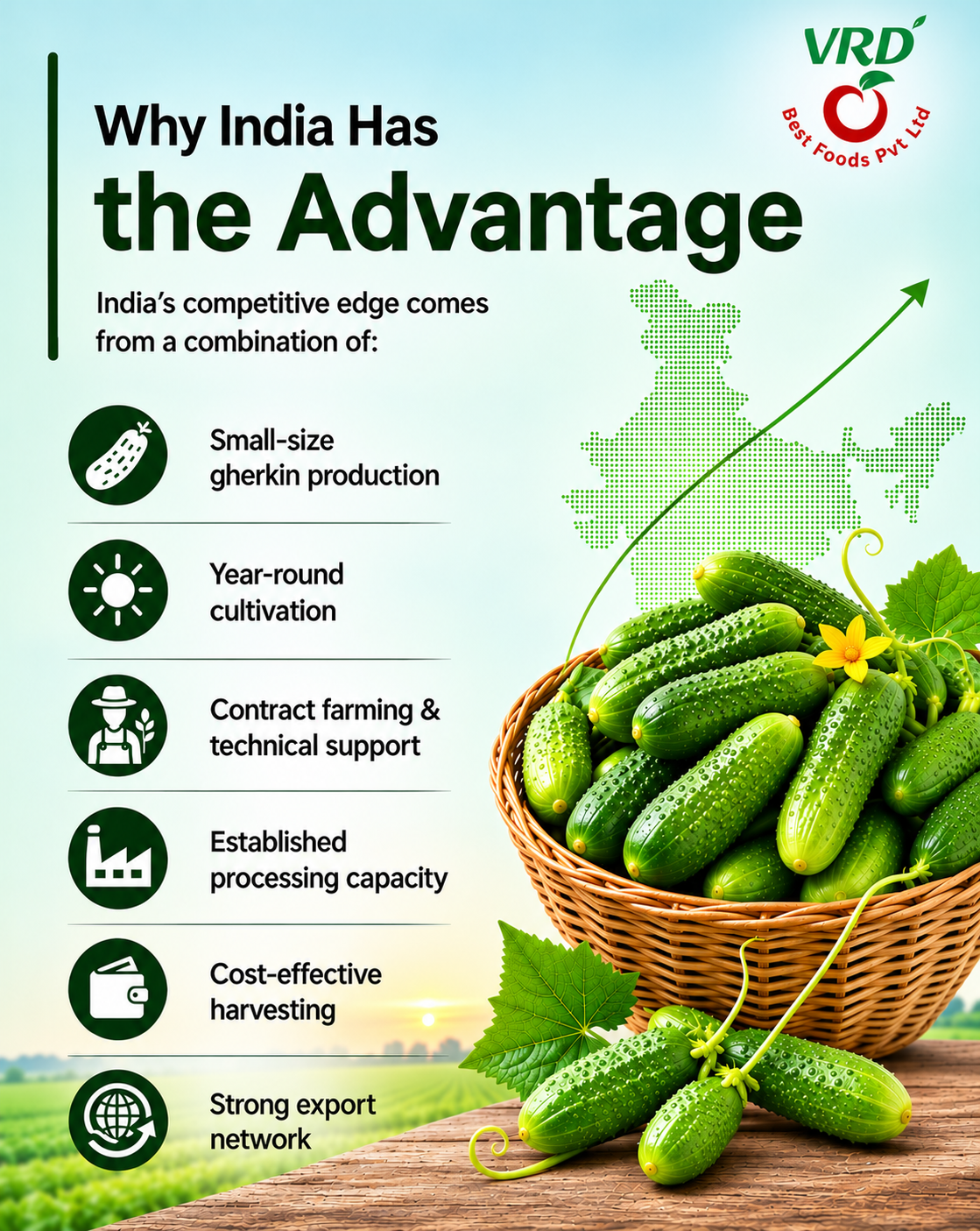
India has developed significant capabilities in agricultural production and food processing, creating opportunities in the international gherkin industry. With suitable agricultural conditions, experienced farming communities, processing infrastructure and export-oriented businesses, India is a competitive sourcing destination for small-size gherkins.
Gherkins, commonly known as baby cucumbers, are widely used in the international food industry, particularly for pickles, preserved vegetables, sandwiches, burgers and ready-to-eat food products.
The growing demand for processed and preserved vegetables creates opportunities for Indian farmers, manufacturers, processors and exporters.
But what makes India an attractive destination for gherkin production and sourcing?
Let’s explore six important advantages that contribute to India’s competitive position in the global gherkin market.
1. Small-Size Gherkin Production
One of India’s important strengths is its ability to cultivate and supply small-size gherkins that meet different food processing requirements.
Small-size gherkins are widely used in the production of pickles and preserved vegetable products. Their size, texture and suitability for processing make them an important raw material for international food manufacturers.
Organized cultivation and proper harvesting practices help maintain the required specifications for processing and export markets.
For international buyers, sourcing from experienced Indian gherkin suppliers can provide access to a range of product sizes and processing requirements.
2. Year-Round Gherkin Cultivation
Agricultural production throughout the year is an important advantage for the gherkin industry.
India’s diverse agro-climatic conditions offer opportunities for cultivation across different regions and seasons.
With proper crop planning, irrigation facilities, farmer coordination and agricultural management, production can be organized across multiple cultivation cycles.
Year-round cultivation opportunities help support:
- Better production planning.
- Consistent raw material availability.
- Improved farmer engagement.
- Organized procurement schedules.
- Better coordination with processing facilities.
This makes India an attractive destination for businesses looking for organized gherkin sourcing.
3. Contract Farming and Technical Support
Contract farming plays an important role in connecting farmers with food processing companies.
Under an organized contract farming model, farmers and processors coordinate cultivation activities based on specific production requirements.
Technical guidance and agricultural support can help farmers improve crop management, harvesting practices and product quality.
The benefits include:
- Better coordination between farmers and processors.
- Guidance on cultivation practices.
- Improved harvesting management.
- More organized raw material procurement.
- Stronger relationships between agricultural communities and food businesses.
A well-managed contract farming system can support the development of a more structured gherkin supply chain.
4. Established Gherkin Processing Infrastructure
Processing infrastructure is another important factor contributing to India’s position in the global gherkin industry.
Gherkins intended for international markets undergo processing and preservation according to buyer specifications and applicable food safety requirements.
Depending on the product and customer requirements, processing operations may include:
- Raw material inspection.
- Size grading and sorting.
- Washing and cleaning.
- Brining or pickling.
- Quality inspection.
- Packaging and storage.
Well-organized processing facilities help businesses maintain product consistency, operational efficiency and supply chain coordination.
For international food companies, reliable processing capabilities are an important consideration when selecting gherkin suppliers.
5. Cost-Effective Harvesting and Agricultural Operations
India’s agricultural workforce and farming ecosystem provide opportunities for competitive production and harvesting operations.
Gherkin cultivation involves several activities, including crop monitoring, regular harvesting, sorting and transportation to processing facilities.
Efficient coordination between farmers, harvesting teams and processors can help reduce operational delays and improve raw material handling.
Cost-effective agricultural operations can contribute to the overall competitiveness of Indian gherkin production.
The focus should remain on balancing production costs with product quality, harvesting standards and customer specifications.
6. Strong Gherkin Export Network
India’s food processing and agricultural export ecosystem creates opportunities to supply gherkin products to international markets.
Gherkins are used by food manufacturers, distributors, importers and private-label brands across different countries.
An effective export network depends on several important factors:
- Consistent product quality.
- International buyer specifications.
- Proper processing and packaging.
- Food safety compliance.
- Reliable shipment planning.
- Effective communication with overseas buyers.
These factors help build long-term relationships between Indian manufacturers and international food businesses.
India’s gherkin industry therefore has opportunities to strengthen its presence in the global processed vegetable market.
Why International Buyers Consider India for Gherkin Sourcing
International buyers evaluate several factors before selecting a gherkin manufacturing or exporting partner.
These include product specifications, processing capabilities, quality management, supply consistency, pricing and export coordination.
India offers an agricultural and processing ecosystem that can support these requirements.
For importers, food processing companies, pickle manufacturers and distributors, working with an experienced Indian supplier can create opportunities for long-term sourcing partnerships.
Choosing the right manufacturing and export partner is essential for maintaining consistency throughout the supply chain.
VRD – Best Foods Pvt Ltd: Connecting Indian Agriculture with Global Markets
At VRD – Best Foods Pvt Ltd, we recognize the importance of India’s agricultural capabilities and the opportunities available in the global gherkin industry.
The gherkin value chain connects farmers, agricultural operations, processing facilities and international markets.
By focusing on organized agricultural sourcing and the importance of processing quality, businesses can contribute to strengthening India’s position in the international food industry.
Our broader vision is to support agricultural growth, promote quality gherkin production and connect Indian agricultural capabilities with global market opportunities.
We believe that India’s agricultural strengths can play an important role in the future of the global gherkin industry.
Conclusion: India’s Future in the Global Gherkin Market
India’s competitive position in the gherkin industry is supported by several important factors:
- Small-size gherkin production.
- Year-round cultivation opportunities.
- Contract farming and technical support.
- Established processing capacity.
- Cost-effective harvesting operations.
- A strong agricultural export ecosystem.
Together, these advantages create opportunities for farmers, processors, manufacturers and international buyers.
As global food businesses continue to explore reliable sourcing destinations, India has the potential to strengthen its role in the processed vegetable and gherkin export industry.
VRD – Best Foods Pvt Ltd believes in the potential of Indian agriculture and its connection to global food markets.
India’s Agriculture. India’s Strength. Global Opportunities.