
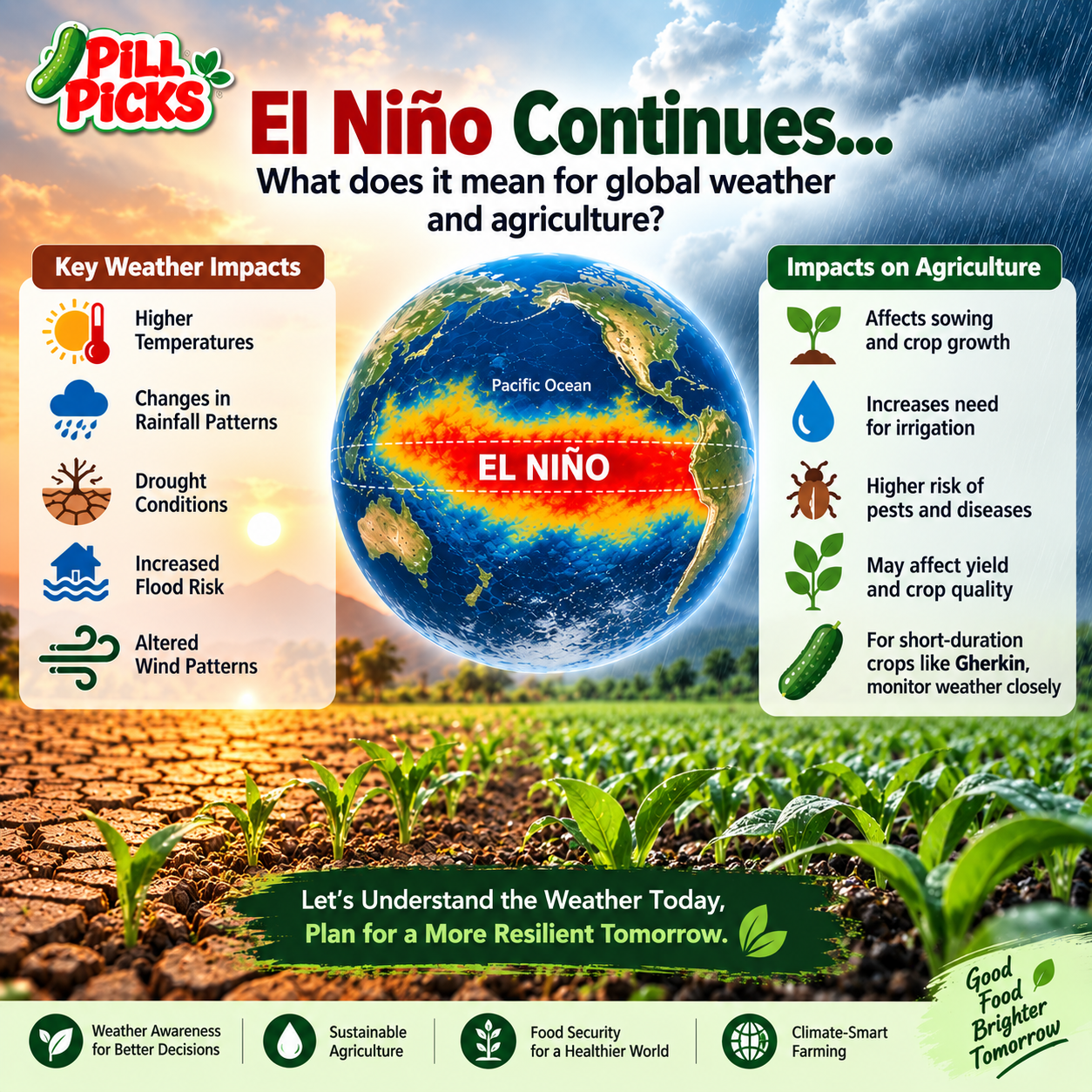
The World Meteorological Organization (WMO) has issued an important update on the current El Niño event. According to its September 2026 update, El Niño is firmly established and is expected to strengthen further, with an exceptionally high likelihood—nearly 100%—that it will persist through February 2027. WMO also expects the event to reach very strong intensity before peaking toward the end of 2026.
For farmers, food businesses and agricultural supply chains, this development is important because El Niño can influence rainfall and temperature patterns across different parts of the world.
🌊 What Is El Niño?
El Niño is a climate phenomenon associated with unusually warm sea-surface temperatures in the central and eastern equatorial Pacific Ocean.
These ocean-temperature changes can influence atmospheric circulation and, in turn, alter weather patterns in different regions.
Depending on the location and season, El Niño can affect:
- 🌧️ Rainfall patterns
- 🌡️ Temperatures
- 💨 Atmospheric circulation
- 🌵 Drought risk
- 🌊 Flood risk
- 🔥 Extreme heat
- 🌾 Agricultural production
However, an important point is that El Niño does not produce the same weather outcome everywhere. WMO emphasizes that the strength of an El Niño event does not directly determine the magnitude of its impact in every region. Local and regional climate drivers also matter.
🌡️ Why Are Pacific Ocean Temperatures Important?
One of the strongest indicators of the current El Niño is the unusually warm tropical Pacific Ocean.
WMO reports that positive sea-surface-temperature anomalies have persisted and intensified across the central and eastern equatorial Pacific. In the Niño 3.4 region, the seasonal average anomaly reached around +1.5°C during May–July 2026, while July values reached approximately +2.0°C. Weekly values from late July to mid-August were around +2.2°C to +2.6°C above average.
WMO also reported significant subsurface ocean warming, with some areas more than 8°C above average during July and early August. These conditions are supporting the continued strengthening of El Niño.
🔥 Is El Niño Expected to Become Stronger?
According to WMO’s latest forecast, yes.
The September 2026 update indicates that El Niño is expected to strengthen further during the coming months, potentially reaching very strong intensity before peaking toward the end of 2026.
The probability of El Niño continuing through:
- September–November 2026
- December 2026–February 2027
is estimated by WMO at nearly 100%.
This does not mean that every region will experience extreme weather. Rather, it means the global climate system is entering a period in which El Niño is likely to be an important influence on weather patterns.
🇮🇳 What Could El Niño Mean for India?
El Niño is an important climate factor for India because it can influence the broader atmospheric circulation associated with rainfall and temperature patterns.
However, it would be misleading to say:
“El Niño automatically means less rainfall in India.”
India’s weather is influenced by multiple climate drivers, including the Indian Ocean Dipole (IOD), Madden-Julian Oscillation (MJO), atmospheric circulation and regional weather systems.
WMO’s September 2026 outlook also indicates the development of a positive Indian Ocean Dipole (IOD), with a September–October–November seasonal mean forecast of around +0.9°C. WMO notes that interactions among different climate drivers can reinforce, weaken or alter typical El Niño impacts in different regions.
Therefore, India’s rainfall and agricultural outlook should be assessed using regional forecasts rather than El Niño alone.
🌾 Why Is El Niño Important for Farmers?
Weather is connected to almost every stage of agricultural production:
Seed Selection → Sowing → Crop Growth → Irrigation → Pest & Disease Management → Harvesting
Changes in rainfall and temperature can affect different stages of this cycle.
💧 1. Water Management
Farmers may need to pay close attention to rainfall forecasts and irrigation requirements.
Efficient water planning can become particularly important when rainfall patterns become less predictable.
🌱 2. Sowing Decisions
Weather forecasts can help farmers assess suitable sowing windows and plan field operations around expected rainfall and temperature conditions.
🌡️ 3. Temperature Monitoring
Higher-than-normal temperatures can affect crop development, flowering and fruit formation in temperature-sensitive crops.
🐛 4. Pest and Disease Management
Changes in temperature, humidity and rainfall can influence the conditions under which certain pests and diseases develop.
Regular field monitoring can therefore be an important part of weather-based crop management.
🥒 What About Gherkin Farming?
Gherkin is a short-duration vegetable crop where weather conditions can be particularly relevant during flowering and fruit development.
Farmers and growers can pay attention to:
- Temperature conditions
- Rainfall forecasts
- Soil moisture
- Irrigation requirements
- Flowering conditions
- Fruit development
- Pest and disease pressure
- Harvest timing
Excessive rainfall or unusually high temperatures at sensitive stages can affect crop growth, yield and quality.
For export-oriented crops such as gherkins, maintaining consistent quality can be particularly important because weather → crop performance → quality → supply are closely connected.
🌍 El Niño and Global Food Supply
The effects of El Niño extend beyond individual farms.
If weather conditions affect crop production in major agricultural regions, the consequences can potentially move through the wider food and commodity system.
A simplified chain looks like this:
Weather → Crop Production → Food Supply → Commodity Prices → Global Trade
Changes in weather can influence:
🌦️ Weather conditions
↓
🌾 Crop production
↓
🍚 Food availability
↓
📈 Commodity markets
↓
🌍 Global trade
This makes El Niño relevant not only to farmers but also to:
- Food-processing companies
- Agricultural exporters
- Importers
- Commodity traders
- Food manufacturers
- Supply-chain businesses
- Retailers
💧 Why Weather-Based Farm Management Matters
Knowing the weather forecast is only the first step.
The real value comes from converting weather information into practical farm decisions.
For example:
Weather Forecast → Farm Decision → Action
A forecast of heavy rainfall may influence irrigation and field operations.
A forecast of high temperatures may encourage closer monitoring of crop conditions and water requirements.
A period of favourable weather may help with harvesting and other field activities.
WMO emphasizes the importance of forecasts, early-warning systems and preparedness as climate risks evolve.
🌱 Climate-Smart Agriculture and the Road Ahead
As climate variability becomes increasingly important for agricultural planning, farmers and agribusinesses can benefit from combining:
- Local weather forecasts
- Seasonal climate outlooks
- Soil-moisture information
- Irrigation planning
- Crop monitoring
- Pest and disease surveillance
- Market information
- Timely agricultural advisories
The objective is not simply to predict the weather, but to use climate information to make better agricultural decisions.
🔎 Key Takeaway
As of September 2026, WMO’s latest assessment says that El Niño is firmly established, is expected to strengthen further, and has a nearly 100% likelihood of persisting through February 2027. WMO expects the event to reach very strong intensity before peaking toward the end of 2026.
At the same time, El Niño should not be interpreted as a guarantee of a specific weather outcome for India or any individual location. Regional climate factors—including the IOD and MJO—also influence local weather.
For agriculture, the key lesson is simple:
Weather forecasting is useful—but turning weather information into timely farm decisions is what can make climate information truly valuable.
For farmers, growers, food processors and agricultural businesses, weather monitoring, water management and climate-smart planning can become increasingly important as El Niño continues into 2027.