
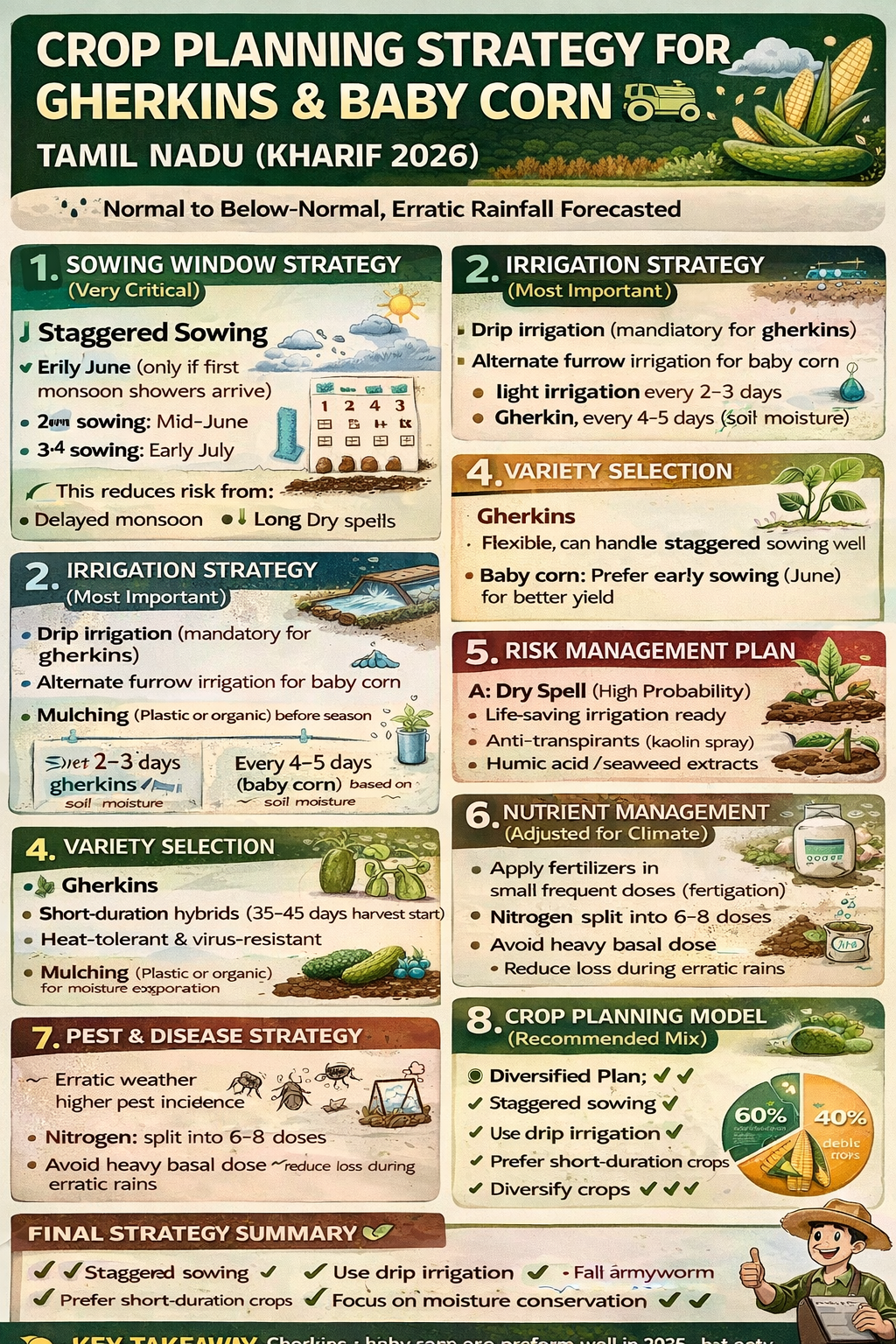
Crop Planning Strategy (Kharif 2026)
1. 📅 Sowing Window Strategy (Very Critical)
✅ Best Approach: Staggered Sowing
- 1st sowing: Early June (only if first monsoon showers arrive)
- 2nd sowing: Mid–June
- 3rd sowing: Early July (backup)
👉 This reduces risk from:
- Delayed monsoon
- Long dry spells
Crop-wise:
- Gherkins: Flexible, can handle staggered sowing well
- Baby corn: Prefer early sowing (June) for better yield
2. 💧 Irrigation Strategy (MOST IMPORTANT)
Since rainfall is unreliable:
Recommended:
- Drip irrigation (mandatory for gherkins)
- Alternate furrow irrigation for baby corn
Schedule:
- Light irrigation every 2–3 days (gherkin)
- Every 4–5 days (baby corn) depending on soil moisture
👉 Install:
- Mulching (plastic or organic) to reduce evaporation
- Farm ponds / water storage before season
3. 🌾 Variety Selection
Gherkins:
- Choose short-duration hybrids (35–45 days harvest start)
- Prefer heat-tolerant & virus-resistant varieties
Baby Corn:
- Short-duration hybrids (60–70 days)
- Good options: hybrids suitable for high temperature & moisture stress
👉 Avoid long-duration varieties due to dry spell risk
4. 🌿 Soil & Moisture Management
Key practices:
- Raised beds for gherkins (better drainage + root aeration)
- Add:
- FYM / compost: 8–10 tons/acre
- Cocopeat or organic matter for moisture retention
Mulching:
- Black/silver mulch for:
- Moisture conservation
- Weed control
- Temperature regulation
5. ⚠️ Risk Management Plan
A. Dry Spell (High Probability)
- Keep life-saving irrigation ready
- Use:
- Anti-transpirants (kaolin spray)
- Humic acid / seaweed extracts
B. Heavy Rain (Short bursts)
- Ensure drainage channels
- Avoid waterlogging (critical for gherkins)
6. 🌱 Nutrient Management (Adjusted for Climate)
Split application is key:
- Apply fertilizers in small frequent doses (fertigation)
Example:
- Nitrogen → split into 6–8 doses
- Avoid heavy basal dose → reduces loss during erratic rains
7. 🐛 Pest & Disease Strategy
Erratic weather → higher pest incidence
Watch for:
- Fruit fly (gherkin)
- Aphids / thrips (both crops)
- Fall armyworm (baby corn)
Strategy:
- Install traps early
- Weekly monitoring
- Preventive sprays instead of reactive
8. 📊 Crop Planning Model (Recommended Mix)
Instead of 100% single crop:
Diversified Plan:
- 60% Gherkins (export potential, quick returns)
- 40% Baby Corn (short cycle, risk hedge)
👉 Ensures:
- Cash flow stability
- Risk diversification
9. 📍 Location-Based Insight (Tamil Nadu)
- Western belt (Coimbatore, Erode, Nilgiris):
- Better rainfall → higher gherkin success
- Interior districts (Madurai, Dindigul, Trichy):
- Depend on irrigation → prioritize baby corn + drip
- Delta areas:
- Use early sowing advantage
✅ Final Strategy Summary
👉 Play safe, not aggressive in Kharif 2026
- Stagger sowing ✔️
- Use drip irrigation ✔️
- Prefer short-duration crops ✔️
- Focus on moisture conservation ✔️
- Diversify crops ✔️
💡 Key Takeaway
Gherkins + baby corn can perform well in 2026—but only with irrigation support and risk management.
Rainfall alone will NOT be sufficient.
For more info Visit: www.vrdbestfoods.in