
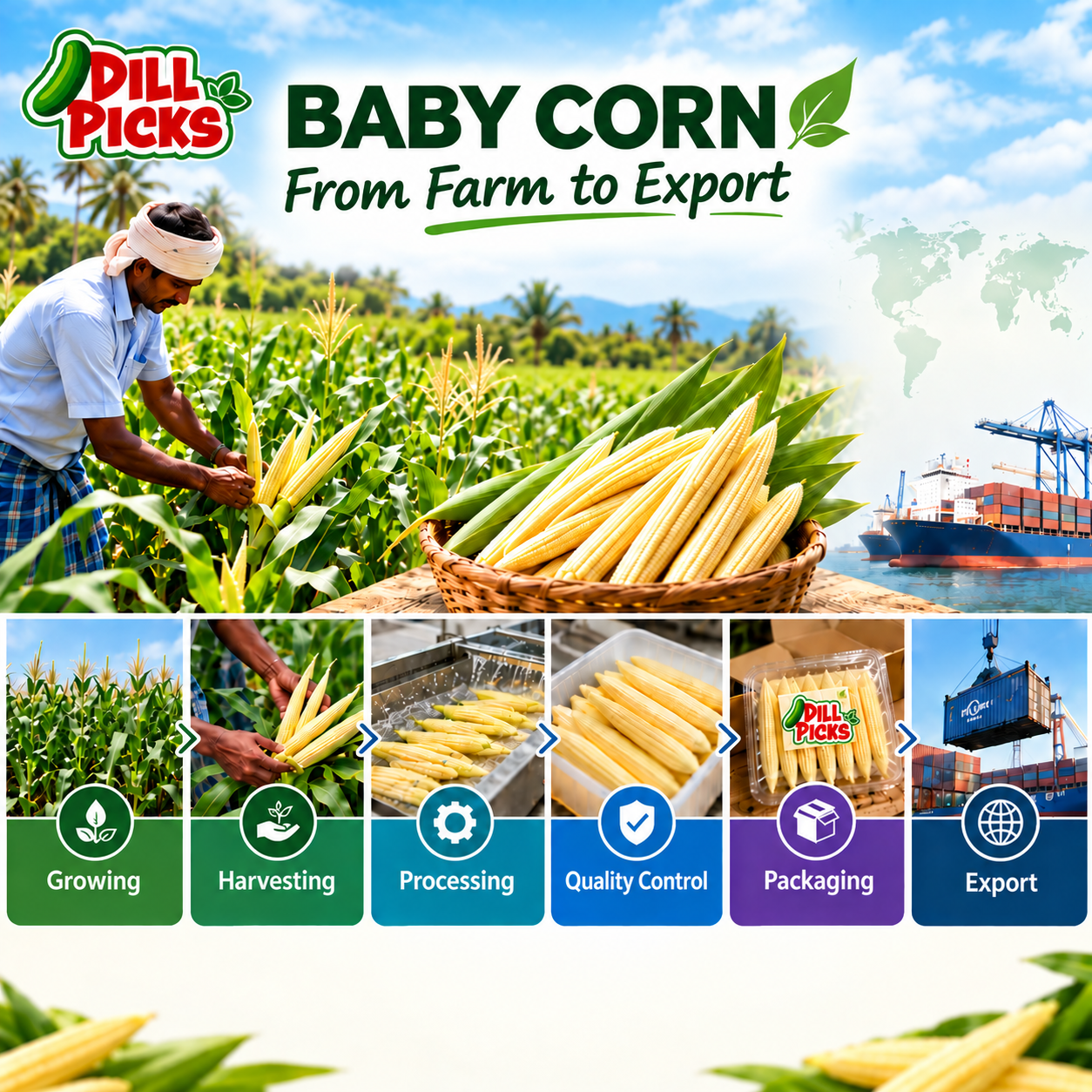
Baby Corn Farming and Processing in Tamil Nadu – From Farm to Export
Baby corn is the young, tender ear of maize (Zea mays), harvested before the corn kernels develop. Because of its crisp texture, mild flavour and attractive appearance, baby corn is widely used in restaurants, food-service, retail and processed food products.
India has good potential for baby corn farming, processing and export, particularly in regions where farmers have access to irrigation, suitable soil and established vegetable markets.
At VRD Best Foods, we believe that quality starts at the farm. From careful crop selection and harvesting to processing and packing, every stage plays an important role in delivering consistent-quality vegetables.
What is Baby Corn?
Baby corn is harvested at a very young stage of the maize crop, usually when the ear is tender and the silks have just emerged.
Unlike mature maize, baby corn is harvested before the kernels develop.
It can be used in:
- Stir-fried vegetables
- Asian cuisine
- Salads
- Soups
- Pickles
- Canned vegetables
- Ready-to-cook products
- Food-service products
The maize plant also produces green stalks and other plant material that can be used as cattle feed.
Baby Corn Farming in Tamil Nadu
Tamil Nadu has favourable conditions for growing baby corn in several regions, particularly where farmers have access to irrigation and suitable agricultural practices.
Baby corn is a short-duration crop, allowing farmers to harvest young ears relatively quickly.
For commercial production, farmers should focus on:
- Good-quality seeds
- Suitable varieties
- Proper plant spacing
- Balanced nutrition
- Efficient irrigation
- Pest management
- Timely harvesting
Soil and Land Preparation
Baby corn grows well in fertile, well-drained soil.
Before planting, the field should be properly prepared to provide good soil conditions for seed germination and root development.
For commercial cultivation, drip irrigation can help supply water efficiently and maintain uniform crop growth.
Good land preparation also makes it easier to manage fertilizer application, irrigation and harvesting.
Baby Corn Seed Rate and Planting
A seed rate of around 20–25 kg per hectare may be used depending on the variety, seed size and planting system.
For dedicated baby corn production, higher plant populations are commonly used.
One example is:
Spacing: 45 cm × 20 cm
Plants: 2 plants per hill
Plant population: approximately 1.75 lakh plants per hectare
The actual spacing should be selected according to the variety, soil, irrigation system and local agricultural recommendations.
Choosing the Right Baby Corn Variety
Variety selection is important for commercial baby corn production.
Farmers should preferably select varieties or hybrids that are:
- Early maturing
- Short in height
- Uniform in growth
- Prolific in ear production
- Suitable for high-density planting
- Suitable for the intended market
Some varieties and hybrids reported for baby corn production include HIM 123, VL-42, HIM 129, Pusa Composite-1, Surya, Madhuri, Priya Sweet, Ganga-9, DHM-107, Vivek Hybrid-9 and Prakash.
The final choice should be based on local growing conditions and buyer requirements.
Fertilizer and Irrigation Management
Baby corn grows rapidly and requires good nutrient management.
A commonly reported nutrient recommendation is:
- Nitrogen – 150–200 kg/ha
- Phosphorus – 60 kg/ha
- Potassium – 40 kg/ha
Nitrogen can be divided into different applications during crop growth.
However, fertilizer requirements should ideally be based on soil-test results and local recommendations.
Where drip irrigation is available, fertigation can help deliver nutrients along with irrigation water and improve nutrient-use efficiency.
Pest Management
Baby corn can be affected by pests such as stem and stalk borers.
Regular field monitoring is important.
Farmers should use an Integrated Pest Management (IPM) approach, including:
- Regular crop inspection
- Good field sanitation
- Crop rotation
- Biological control methods where appropriate
- Timely use of currently approved crop-protection products
Only pesticides currently approved for the crop and intended market should be used, following label directions and pre-harvest intervals.
Baby Corn Harvesting
Harvesting at the correct stage is one of the most important steps in baby corn production.
The ears should be harvested when they are:
- Young
- Tender
- Small
- Crisp
- Suitable for the required market size
Harvesting may begin at around 45–50 days after sowing, depending on variety, season and growing conditions.
The crop should be checked frequently because baby corn develops quickly.
Harvesting every 2–3 days may be required during the harvesting period.
Morning harvesting is generally preferred because temperatures are lower and the harvested product can be handled more easily.
Baby Corn Grading and Quality
For fresh markets and processing industries, uniformity is very important.
A commonly used commercial size range is approximately:
Length: 4.5–10 cm
Diameter: 7–17 mm
However, specifications can vary depending on the customer and end product.
Good-quality baby corn should be:
- Fresh
- Tender
- Uniform
- Straight
- Free from physical damage
- Free from pest damage
- Suitable in size and colour
From Farm to Processing
After harvesting, baby corn needs to be handled carefully to maintain freshness and quality.
The basic process includes:
Harvesting → Dehusking → Desilking → Trimming → Grading → Packing → Processing
Careful handling is important because baby corn is tender and can easily be damaged.
Fresh baby corn should be cooled and moved quickly to the next stage of the supply chain.
Baby Corn Processing in India
Baby corn can be converted into several value-added products.
These include:
Canned Baby Corn
Baby corn can be processed and packed in cans for longer shelf life and convenient use.
Baby Corn in Brine
Baby corn can be preserved in a suitable brine-based formulation and packed for retail and food-service applications.
Pickled Baby Corn
Baby corn can also be processed as a pickled product using an appropriate acidified formulation.
Chilled and Ready-to-Cook Baby Corn
Fresh baby corn can be prepared and packed for convenient use by restaurants, food-service operators and consumers.
Commercial processing requires suitable food-safety controls, validated processing conditions, hygienic handling and compliant packaging.
Baby Corn Export from India
Baby corn has applications in international retail and food-service markets.
Indian baby corn can be supplied to:
- International food distributors
- Retailers
- Hotels and restaurants
- Food-service companies
- Vegetable processors
- Canning companies
- Pickle manufacturers
- Importers and exporters
For export markets, customers generally expect consistent quality and reliable supply.
Important factors include:
Quality + Food Safety + Grading + Traceability + Packaging + Consistent Supply
Why Farm-to-Fork Management Matters
Baby corn quality starts well before the processing plant.
Good agricultural practices can help improve the consistency of the raw material supplied for processing.
A strong farm-to-fork approach connects:
Farmer → Crop Management → Harvesting → Collection → Processing → Quality Control → Packing → Customer
This approach helps create better control over product quality and traceability.
Opportunity for Farmers and Food Processors
Baby corn provides opportunities at different stages of the agricultural and food-processing value chain.
Farmers can benefit from:
- Short crop duration
- Multiple harvests
- Demand from fresh markets
- Processing opportunities
- Additional green fodder
Food processors can create additional value through:
- Grading
- Packing
- Canning
- Pickling
- Ready-to-cook products
- Export
This makes baby corn an interesting crop for an integrated farm-to-food-processing business model.
Conclusion
Baby corn is more than just a young maize crop. It is a value-added vegetable with opportunities from farming to processing and export.
With suitable varieties, proper crop management, efficient irrigation, timely harvesting and careful post-harvest handling, farmers can produce good-quality baby corn.
For processors and exporters, maintaining food safety, consistent quality, traceability and reliable supply is essential.
From Tamil Nadu farms to international markets, a well-managed baby corn supply chain can create value for farmers, processors, exporters and customers.
At VRD Best Foods, our focus is on connecting quality agricultural produce with modern food processing and market requirements — supporting the journey from farm to fork.