
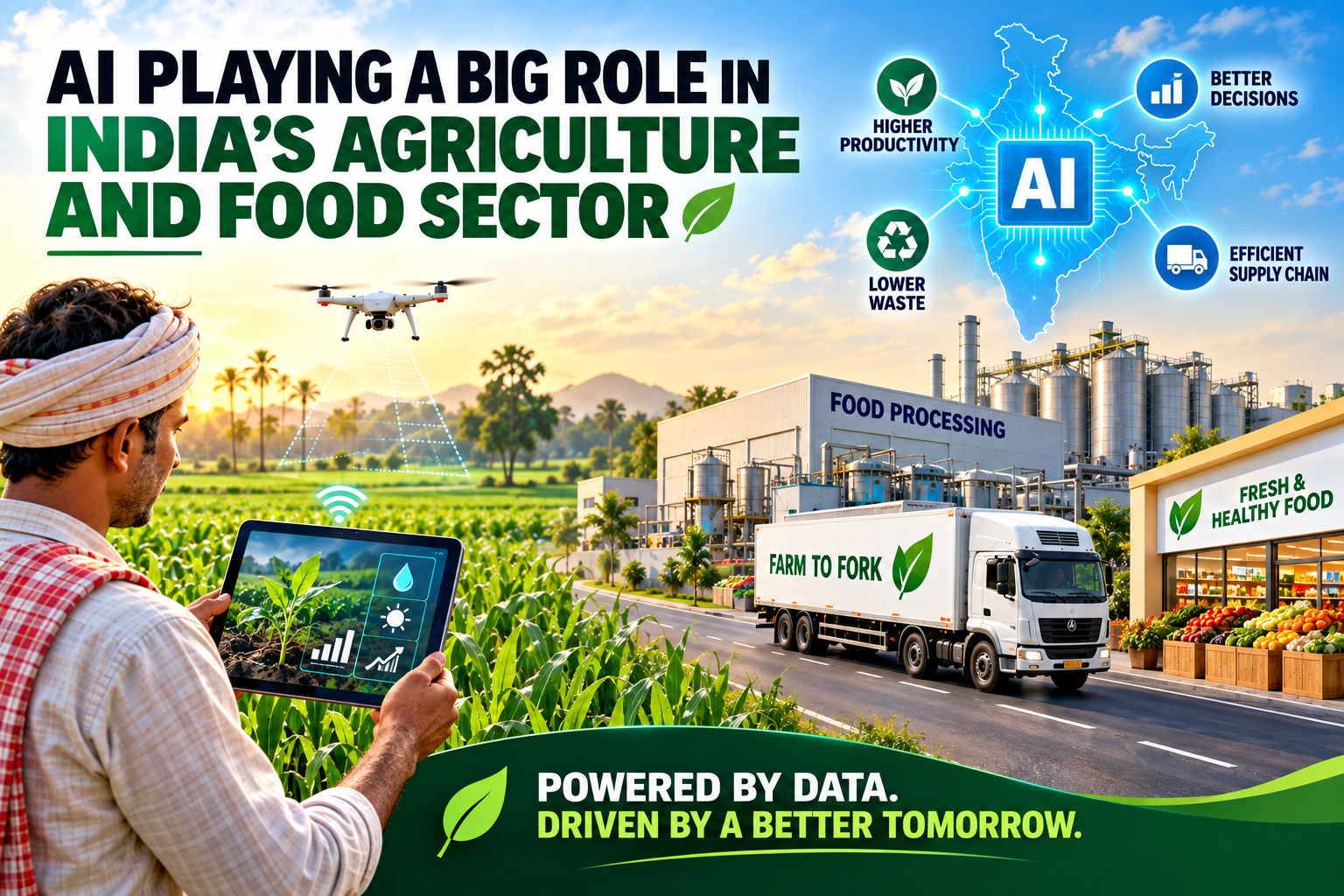
Artificial Intelligence (AI) is rapidly emerging as a powerful technology for India’s agriculture and food sector. From farm-level decision-making to food processing, inventory management, logistics and exports, AI can help businesses and farmers use data more effectively, improve operational efficiency and reduce avoidable waste.
As highlighted by Kunal Singhal, Managing Director of Eazy Business Solutions, businesses that delay technology adoption may eventually find themselves at a disadvantage as data-driven operations become increasingly important.
AI in Indian Agriculture: From Data to Better Decisions
India’s agriculture sector generates vast amounts of information related to soil, weather, crops, water availability, farm productivity, markets and supply chains. Traditionally, analysing this information manually has been time-consuming.
AI can help transform this data into actionable insights.
AI-powered agricultural systems can analyse large datasets, identify patterns and generate alerts or recommendations. This can support farmers and agricultural businesses in making more informed decisions.
For example, AI applications in agriculture can potentially help with:
- Irrigation and water-management decisions
- Crop selection and suitability analysis
- Early identification of pest and disease risks
- Crop monitoring and yield estimation
- Weather-based farm planning
- Agricultural demand forecasting
- Market and price analysis
The objective is not to replace human decision-making, but to provide better information that can support farmers and businesses.
AI and the Farmer of the Future
One of the important opportunities for AI in agriculture is improving visibility into farm conditions.
Digital agriculture platforms can combine information from multiple sources to provide insights into:
- Soil conditions
- Water availability
- Land characteristics
- Crop suitability
- Farm productivity
- Weather conditions
- Market opportunities
When farmers have access to better information, they can potentially make more timely decisions about crop management and resource utilisation.
The traditional question of:
“What should I do today?”
can increasingly become:
“What does the available data indicate I should do next?”
This shift toward data-driven farming can support more efficient use of land, water, labour and other agricultural resources.
How AI Can Help Reduce Food Supply Chain Waste
The role of AI does not end at the farm.
The food supply chain involves multiple stages, including procurement, aggregation, processing, storage, transportation, distribution and retail. Managing these interconnected activities efficiently is particularly important for agricultural and perishable food products.
AI and digital supply-chain systems can help businesses analyse:
What to stock → Where to stock → When to move → Where to deliver
AI-powered forecasting and inventory systems can potentially help companies:
- Forecast demand
- Monitor inventory levels
- Identify supply-chain bottlenecks
- Improve warehouse planning
- Optimise transportation routes
- Reduce unnecessary delays
- Improve distribution planning
For perishable agricultural products, better planning can be especially valuable because delays and inefficient storage can contribute to product losses and financial costs.
AI in Food Processing and Manufacturing
The food processing industry in India is another area where AI can create opportunities for operational improvement.
A food-processing company can generate data across procurement, production, quality control, inventory, logistics and sales.
AI can analyse this information to potentially identify:
- Raw-material requirements
- Production requirements
- Inventory trends
- Production bottlenecks
- Quality trends
- Supply-chain inefficiencies
- Transportation requirements
- Customer-demand patterns
For food manufacturers, integrating these different data points can create a more connected view of the business.
Instead of analysing procurement, production and logistics separately, companies can begin looking at the entire operation as an interconnected system.
AI for Agricultural and Food Exports
AI can also play a role in agricultural exports and food manufacturing for international markets.
Export-oriented companies often manage a complex network involving:
Farmers → Aggregators → Processing Plants → Warehouses → Ports → Shipping → Distributors → International Customers
Managing this chain requires coordination, accurate information and timely decisions.
AI-based systems can potentially support:
- Procurement forecasting
- Production planning
- Inventory optimisation
- Logistics planning
- Demand forecasting
- Shipment planning
- Customer-demand analysis
- Supply-chain monitoring
For exporters of agricultural and processed food products, improving visibility across the supply chain can help businesses identify inefficiencies and respond to changing demand more effectively.
AI, IoT and Satellite Data: Building a Digital Agriculture Ecosystem
The future of smart agriculture in India is unlikely to depend on AI alone.
The combination of multiple technologies can create a more comprehensive digital ecosystem.
AI + IoT + Satellite Data + Weather Data + Farm Data + Digital Supply Chains
IoT devices can generate real-time information from farms and facilities. Satellite data can provide information about land and crop conditions. Weather data can support agricultural planning, while AI can analyse these different information sources.
Together, these technologies can potentially support:
- Precision agriculture
- Crop monitoring
- Water management
- Weather-based decision-making
- Yield forecasting
- Supply-chain optimisation
- Resource management
- Agricultural risk management
This creates an opportunity to move from simply collecting agricultural data to using that data for practical decision-making.
Why AI Adoption Matters for India’s Food Industry
Technology adoption is increasingly becoming a business strategy rather than simply an IT investment.
Food companies operate in an environment where efficiency, speed, quality, cost management and supply-chain visibility are important.
Businesses that use digital technologies can potentially improve their ability to:
- Analyse information quickly
- Forecast demand
- Manage inventory
- Plan production
- Monitor operations
- Optimise logistics
- Identify inefficiencies
- Respond to market changes
However, successful AI adoption also depends on data quality, appropriate technology, skilled people, infrastructure and effective implementation. AI should therefore complement industry expertise rather than operate independently of it.
The Future of AI in Indian Agriculture
India’s agricultural ecosystem presents significant opportunities for digital transformation because of its diverse farming systems, varied agro-climatic conditions, expanding food-processing sector and increasingly connected supply chains.
The growing combination of AI, IoT, satellite technology, weather information and digital supply-chain platforms could contribute to a more data-driven agricultural ecosystem.
The potential objectives are straightforward:
Better decisions + Higher productivity + Efficient resource use + Lower waste + Better supply-chain visibility
For farmers, food processors, exporters and distributors, digital technologies can increasingly become part of everyday business operations.
What AI Means for the Future of India’s Food Industry
The future food industry may compete on more than product quality and price.
It may also increasingly compete on how effectively companies manage information, resources and supply chains.
Companies that combine agricultural expertise with AI and digital technologies can potentially improve operational visibility—from farm procurement to food processing, logistics and the final customer.
The next agricultural transformation may therefore involve not only machines and equipment in the field, but also intelligence derived from data.
AI is moving from a futuristic concept to a practical business tool. Its effective adoption can help build a more productive, efficient and competitive agriculture and food sector in India.