
Agriculture is entering a new era. While artificial intelligence receives much of the attention, many other emerging technologies are quietly changing how crops are grown, how plants respond to their environment, and how farmers can build more productive and resilient agricultural systems.
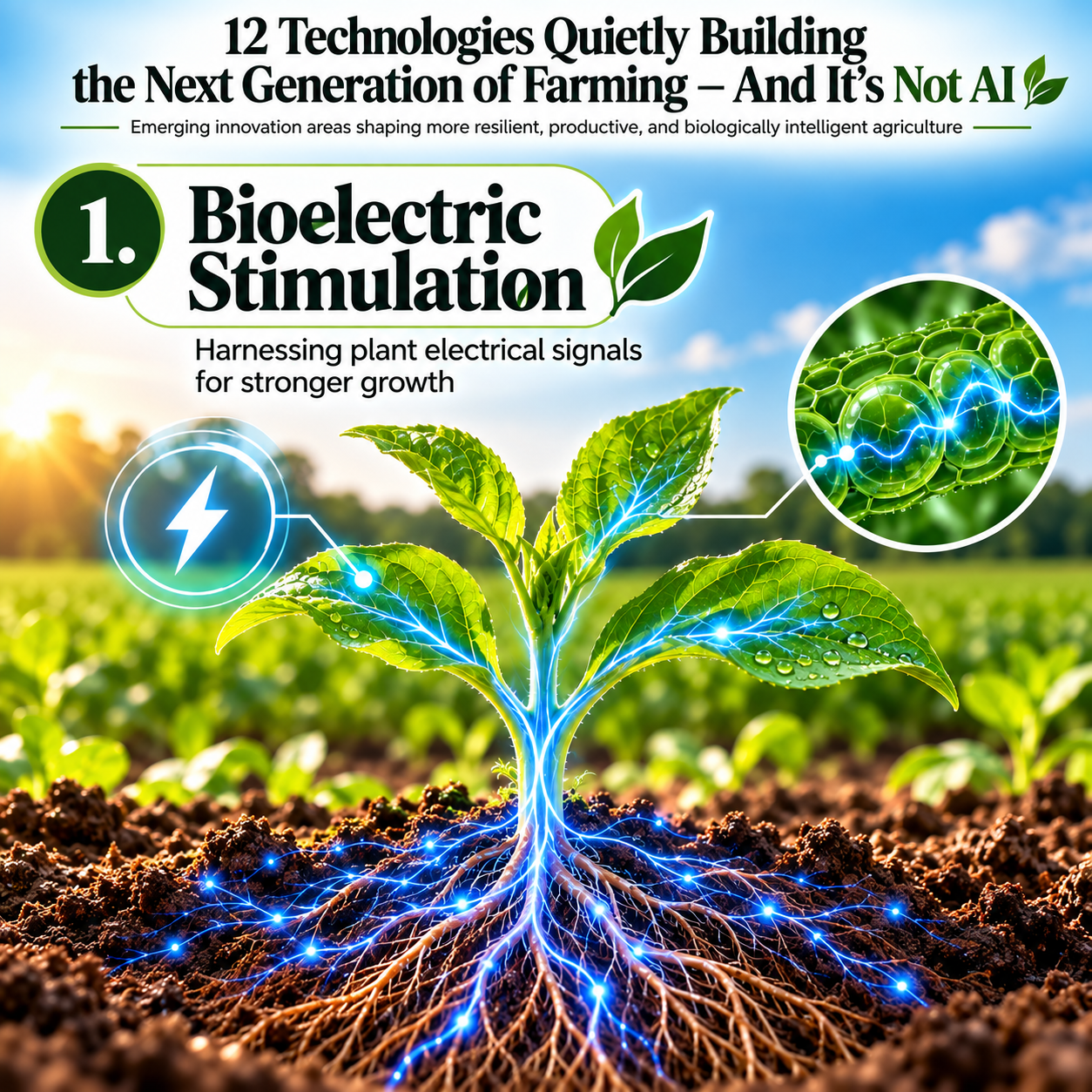
The infographic highlights 12 technologies quietly building the next generation of farming, describing them as emerging innovations designed to support more resilient, productive and biologically intelligent agriculture.
One of the technologies highlighted in the image is bioelectric stimulation, an interesting approach that explores how electrical signals can influence plant growth.
1. Bioelectric Stimulation: Using Electrical Signals for Plant Growth
Plants naturally generate and respond to electrical signals. Researchers are exploring whether these biological signals can be influenced to support plant development and improve how crops respond to environmental conditions.
The infographic describes bioelectric stimulation as harnessing plant electrical signals for stronger growth.
This represents an exciting area of agricultural research because it looks beyond traditional inputs and focuses on the biological processes that already exist within plants.
Why Bioelectric Stimulation Matters
Understanding electrical signaling in plants could potentially contribute to:
- Better understanding of plant growth mechanisms
- Improved plant responses to environmental stress
- New approaches to crop production
- More biologically informed agricultural practices
- Research into sustainable alternatives to conventional interventions
Rather than simply adding more external inputs, technologies like bioelectric stimulation investigate how plants themselves communicate and respond.
The Shift Toward Biologically Intelligent Agriculture
Modern agriculture is increasingly focused on understanding the complex biological systems that support healthy crops.
The next generation of farming may combine technologies involving:
Plants + Soil + Microorganisms + Sensors + Biology + Data
This approach can help researchers and farmers better understand what crops need and how agricultural systems respond to changing environmental conditions.
Why Emerging Agricultural Technology Is Important
Farmers worldwide face challenges including changing weather patterns, soil degradation, water availability, crop diseases and the need to produce more food efficiently.
Emerging agricultural technologies can contribute to solutions by focusing on areas such as:
🌱 Crop Resilience
Technology can help researchers understand how plants respond to environmental stresses and identify ways to support healthier crops.
💧 Resource Efficiency
Modern farming innovations increasingly focus on using water, nutrients and other agricultural resources more efficiently.
🦠 Biological Agriculture
Advances in plant biology, microbiology and biotechnology are creating new possibilities for understanding the relationships between crops, soil and microorganisms.
🌾 Sustainable Farming
New technologies can support agricultural systems that aim to maintain productivity while reducing unnecessary resource use.
Beyond AI: The Future of Agriculture Is Bigger Than One Technology
The title of the infographic makes an important point: the future of farming is not only about AI.
Artificial intelligence can certainly support agriculture through data analysis, forecasting, automation and decision-making. But agricultural innovation extends far beyond software.
The future may also involve advances in:
- Plant biology
- Soil science
- Agricultural biotechnology
- Biological inputs
- Robotics
- Sensors
- Controlled-environment agriculture
- Genetic research
- Water-management technologies
- Crop monitoring
- Sustainable production systems
Together, these technologies can contribute to a more connected and biologically informed agricultural ecosystem.
What This Means for Farmers and the Food Industry
For farmers, agricultural innovation isn’t simply about adopting the newest technology. The real value comes from understanding whether an innovation can solve a practical problem.
The most useful technologies will need to demonstrate benefits such as improved crop performance, efficient resource use, reliable implementation and economic viability.
For the wider food industry, advances in agricultural technology could eventually influence how crops are produced, processed, supplied and brought to consumers.
The Future of Farming Is Being Built Quietly
The agricultural technologies receiving the most attention aren’t necessarily the only ones shaping the future.
Innovations such as bioelectric stimulation demonstrate how researchers are looking at agriculture from new perspectives — including the electrical, biological and ecological processes that influence plant growth.
As research progresses, these emerging technologies could become important components of the next generation of smart, sustainable and resilient agriculture.
The future of farming may not be defined by a single breakthrough. Instead, it could emerge from the combination of many technologies working together to better understand plants, soil, water and biological systems.