
Agriculture is entering a new technological era—but the biggest changes may not come from artificial intelligence alone.
Across farms, greenhouses, laboratories, and soil-management systems, researchers and innovators are exploring technologies that work directly with plants, roots, microorganisms, water, light, gases, and biological signals.
The goal is simple: produce more food while using resources such as water, fertilizers, energy, and land more efficiently.
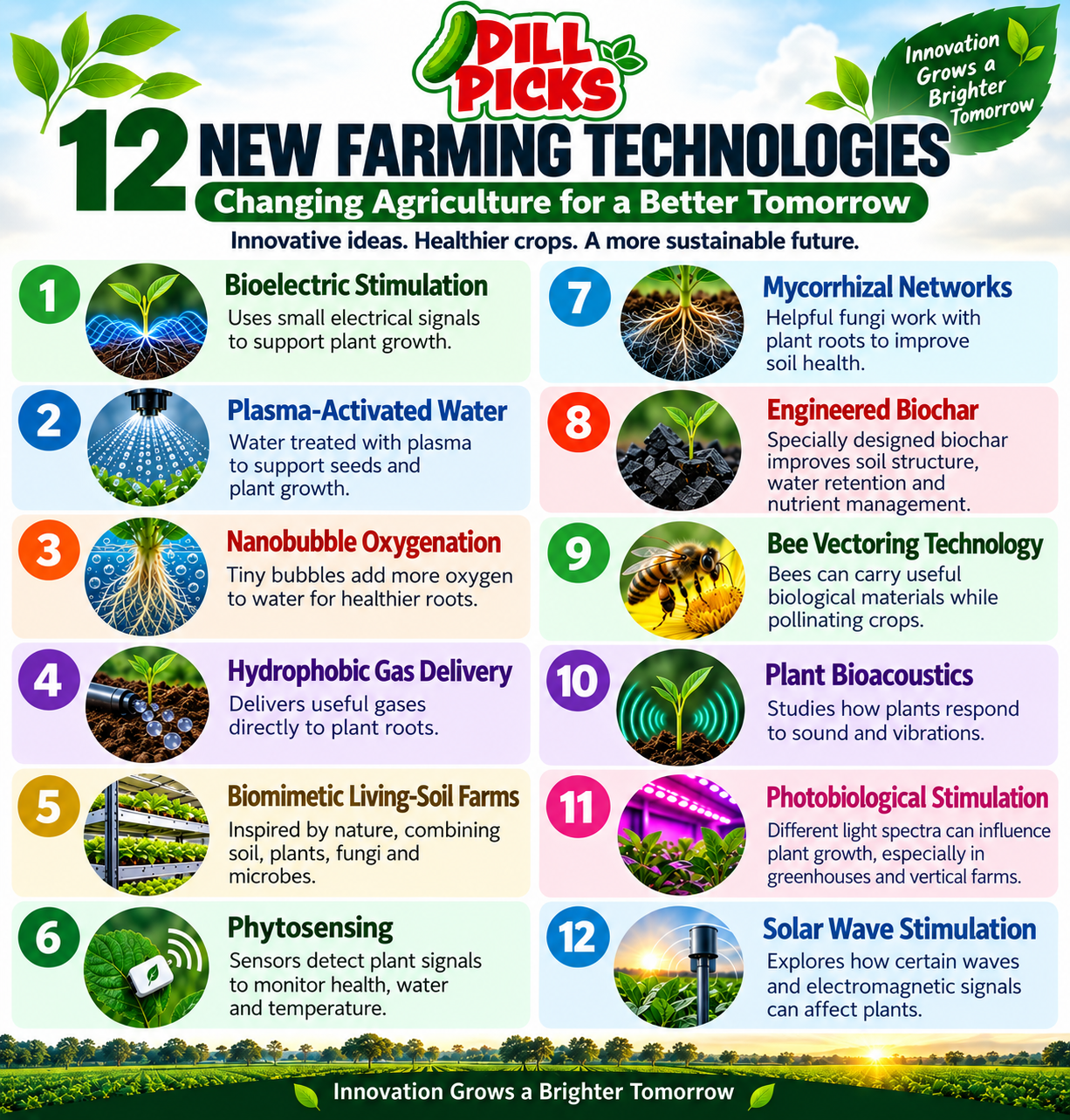
From bioelectric stimulation to engineered biochar, here are 12 emerging technologies that could influence the future of farming.
1. Bioelectric Stimulation
Plants naturally generate and respond to electrical signals. These signals help regulate processes such as growth, stress responses, and communication between different parts of a plant.
Bioelectric stimulation explores whether carefully controlled electrical signals can influence plant development or resilience.
Potential applications include:
- Supporting seed germination
- Influencing root development
- Studying plant stress responses
- Improving controlled-environment agriculture
- Understanding plant signaling
Although the field is still developing, plant electrophysiology could eventually become another tool for precision crop management.
2. Plasma-Activated Water
What if water could do more than simply hydrate a crop?
Plasma-activated water (PAW) is produced by exposing water to plasma, creating reactive chemical species that can change its properties.
Researchers are investigating PAW for applications involving:
- Seed treatment
- Plant growth
- Nutrient availability
- Microbial management
- Sustainable crop production
The technology is particularly interesting because it connects water treatment, plant biology, and agricultural sustainability in one system.
Its practical value will depend on crop type, treatment conditions, production costs, and demonstrated results at agricultural scale.
3. Nanobubble Oxygenation
Healthy roots require oxygen, particularly in hydroponic and other water-based growing systems.
Nanobubble technology introduces extremely small gas bubbles into water. Because of their size and behavior, these bubbles can remain suspended in water for extended periods.
Agricultural applications are being explored for improving oxygen availability in root zones and supporting healthier growing environments.
Potential uses include:
- Hydroponic farming
- Aquaculture
- Irrigation systems
- Root-zone management
- Greenhouse production
For controlled-environment agriculture, managing dissolved oxygen could become an increasingly important part of crop optimization.
4. Hydrophobic Gas Delivery
Another emerging approach involves delivering beneficial gases directly to the plant’s root environment.
Hydrophobic gas-delivery systems use materials or structures that interact with water and gases differently, potentially allowing targeted gas movement within growing systems.
The broader idea is intriguing: instead of treating an entire growing environment, farmers could potentially deliver specific gases where plants need them most.
Applications could eventually include:
- Root-zone oxygen management
- Carbon dioxide delivery
- Controlled-environment agriculture
- Hydroponic systems
- Soil and substrate research
This remains an emerging area, and practical agricultural benefits will require further validation.
5. Biomimetic Living-Soil Vertical Farms
Vertical farming is often associated with stacked shelves, LEDs, and hydroponics. But another concept is emerging: biomimetic living-soil systems designed to imitate some of the biological relationships found in natural ecosystems.
Rather than treating plants as isolated crops, these systems can incorporate:
- Microorganisms
- Organic matter
- Fungi
- Root interactions
- Biological nutrient cycling
The objective is to create more biologically active growing environments while retaining the efficiency and environmental control associated with indoor agriculture.
This could help bridge two traditionally different approaches: controlled-environment farming and ecological soil management.
6. Phytosensing: Letting Plants Provide Data
Plants constantly respond to their environment.
Changes in electrical activity, temperature, water status, growth patterns, and other physiological signals can provide information about plant conditions.
Phytosensing uses sensors and monitoring technologies to capture these signals.
Instead of asking only:
“What does the soil sensor say?”
farmers could increasingly ask:
“What is the plant itself telling us?”
Potential applications include detecting:
- Water stress
- Environmental changes
- Nutrient problems
- Temperature stress
- Other physiological responses
As sensing technologies improve, plant-based measurements could complement conventional agricultural monitoring.
7. Mycorrhizal Network Regeneration
Beneath healthy soil is an enormous biological network.
Mycorrhizal fungi form associations with plant roots and can play important roles in nutrient and water relationships within ecosystems.
Regenerating and maintaining these fungal networks is therefore an important area of interest in soil health and regenerative agriculture.
Potential benefits being investigated include:
- Improved nutrient cycling
- Better soil structure
- Greater biological activity
- Improved plant–microbe interactions
- Increased soil resilience
Rather than viewing soil as an inert growing medium, this approach treats it as a living ecosystem.
8. Engineered Biochar
Biochar is a carbon-rich material produced by heating organic biomass under controlled conditions.
But the future of biochar may involve more than simply adding carbon to soil.
Engineered biochar can be designed or modified to have specific physical and chemical properties. Researchers are exploring how these characteristics affect:
- Soil water retention
- Nutrient availability
- Microbial communities
- Soil structure
- Carbon storage
Because biochar can be produced from various biomass materials, it is also being investigated as part of broader circular agriculture and waste-management systems.
Its effectiveness, however, can vary considerably depending on the feedstock, production method, soil, and application.
9. Bee Vectoring Technology
Pollinators may eventually do more than pollinate crops.
Bee vectoring technology uses bees or other pollinators as natural delivery systems for biological products. As insects move between flowers, specially formulated materials can potentially be transferred to plants.
The concept can be particularly interesting for delivering beneficial microorganisms directly to flowers.
Potential advantages include:
- Targeted biological delivery
- Reduced dependence on broad-area applications
- Integration with pollination
- Potentially lower application volumes
This represents an unusual intersection of entomology, microbiology, crop protection, and precision agriculture.
10. Plant Bioacoustics
Plants don’t have ears—but researchers are investigating how plants interact with and respond to mechanical vibrations and sound-related stimuli.
Plant bioacoustics examines the relationship between acoustic or vibrational signals and plant biology.
Researchers have explored questions such as whether particular vibrations can influence:
- Seed germination
- Root growth
- Plant development
- Stress responses
- Plant–microbe interactions
This field remains experimental, but it raises a fascinating possibility: future agricultural systems could potentially monitor or interact with plants using sound and vibration.
11. Photobiological Stimulation
Light is one of the most powerful environmental signals affecting plants.
Traditional farming largely relies on sunlight, while controlled-environment agriculture can manipulate light intensity and wavelength.
Photobiological stimulation takes this concept further by examining how specific light spectra can influence plant processes.
Different wavelengths can affect characteristics such as:
- Photosynthesis
- Plant architecture
- Flowering
- Pigmentation
- Secondary metabolites
- Growth patterns
This is especially relevant to vertical farms, greenhouses, plant factories, and indoor growing systems.
As LED technology becomes more controllable, farmers can potentially design increasingly precise light environments.
12. Solar Wave Stimulation
The final technology on the list explores another unconventional idea: using subtle electromagnetic, light, or wave-based environmental signals to influence plant growth and vitality.
Solar wave stimulation is an emerging and less-established concept compared with technologies such as controlled LED lighting or soil sensing.
Research into electromagnetic and other wave-based interactions with biological systems continues, but agricultural applications require careful scientific validation.
The concept illustrates a broader trend in agriculture: looking beyond conventional inputs and exploring whether plants respond to physical signals in their environment.
Why These Technologies Matter
The common thread connecting these innovations is not artificial intelligence.
It is biological precision.
Instead of simply adding more fertilizer, water, pesticides, or energy, next-generation agriculture is increasingly exploring ways to understand and manipulate the biological systems that already support plant growth.
That includes:
Plants → electrical signals, physiological responses, acoustics and light
Roots → oxygen, gases, fungi and microorganisms
Soil → carbon, microbial networks and nutrient cycling
Water → oxygenation and reactive chemistry
Pollinators → targeted biological delivery
Controlled environments → precise manipulation of light and growing conditions
The result could be a more integrated model of agriculture in which technology works with biological processes rather than simply replacing them.
The Future of Agriculture May Be More Biological Than Digital
AI, robotics, drones, satellite imagery, and automation are undoubtedly transforming agriculture. But another technological revolution is happening at a smaller scale.
It is happening inside roots, within soil, around plant cells, in water droplets, and across microbial communities.
Some of the technologies discussed above are already being researched or commercialized, while others remain experimental. Their long-term agricultural impact will depend on reproducible research, economics, regulatory considerations, environmental effects, and successful deployment at farm scale.
Still, they point toward an important shift in how we think about farming.
The farm of the future may not simply be a place where machines produce crops.
It could be a highly connected biological ecosystem—where plants, microbes, soil, water, light, and technology work together.
And that may be one of the most interesting developments in agriculture to watch over the next decade.